
Why People Search for MyFitnessPal Alternatives in 2026
Original search data shows how replacement queries intersect with barcode access, free features, pricing, and everyday logging friction. Here is what the sample can tell us, what it cannot, and what to check before switching.
By ProTrack AI Research Team · Published: July 17, 2026 · Updated: September 20, 2026 · Search data: June 17 to July 14, 2026 · Features and prices checked: September 20, 2026
Quick answer
Try ProTrack AI if you want a private iPhone diary with a $39.99 US lifetime option; it requires iOS 26, its free allowance is limited, and new barcode lookups need internet. In our 28-day Search Console sample, 77.4% of barcode-related impressions also involved price, payment, or Premium. The data shows research interest, not completed switches.
What the original Google search data showed
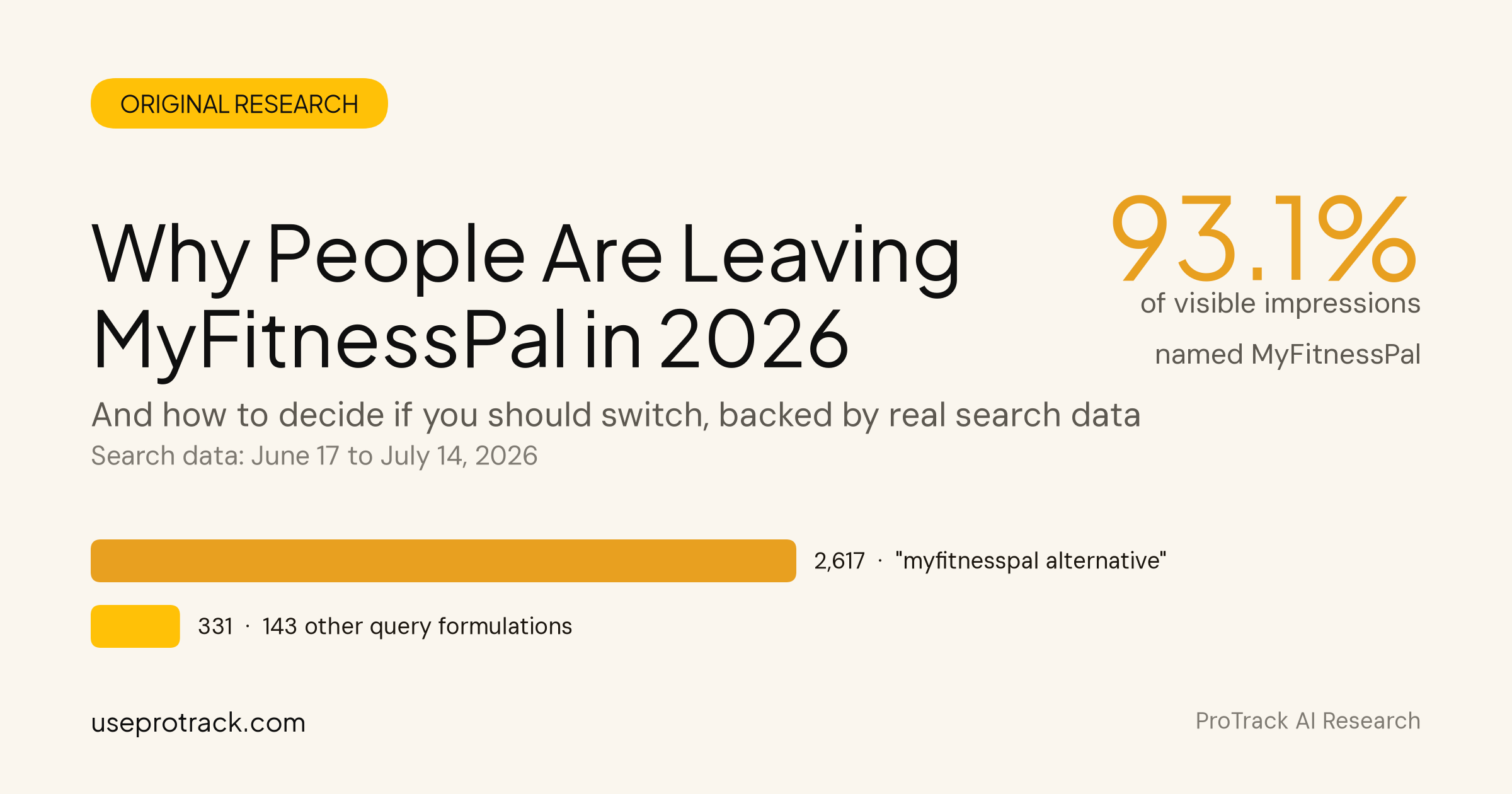
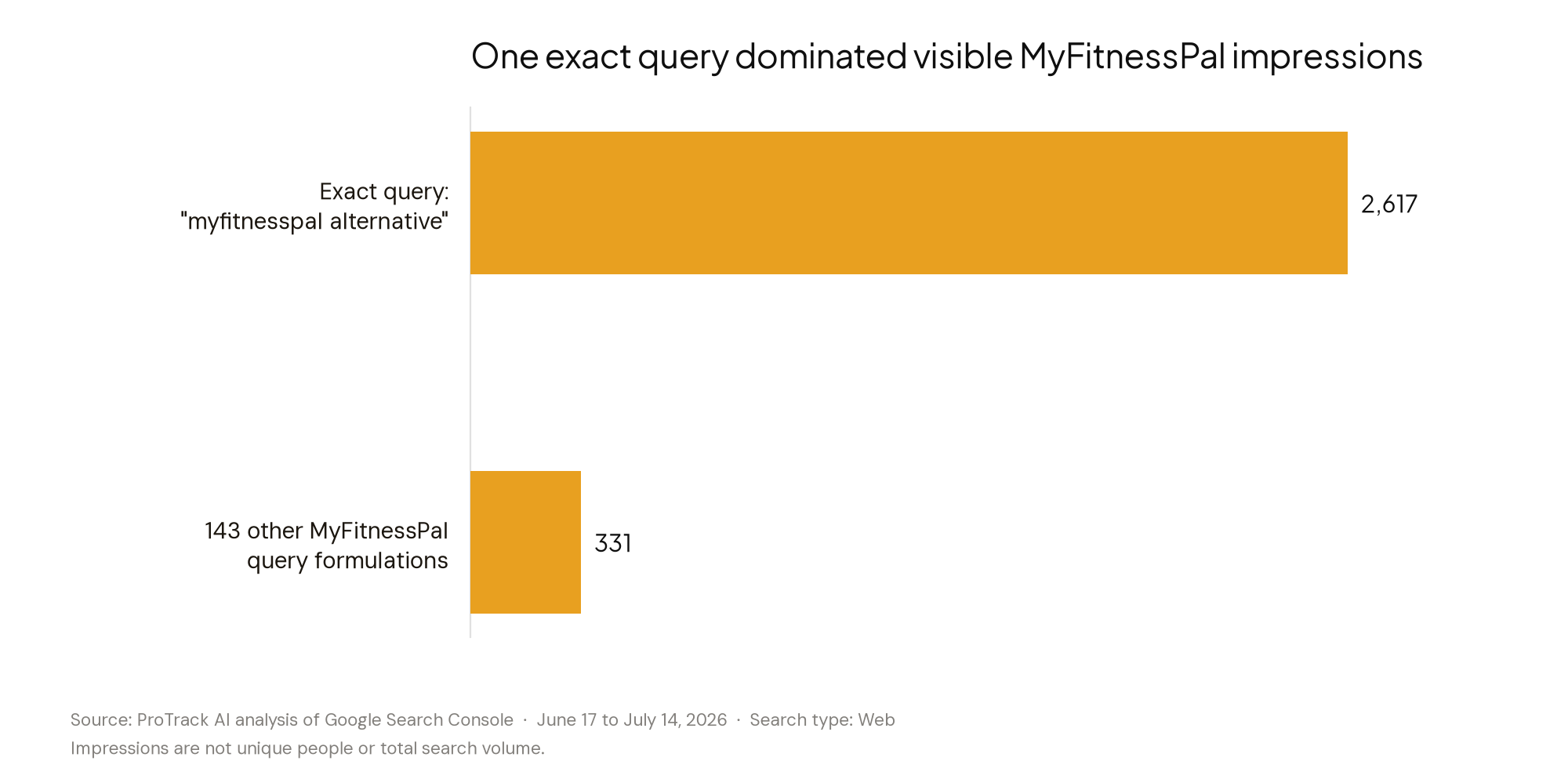
During the 28-day study period, Google showed our site for the exact query "myfitnesspal alternative" 2,617 times. Across the visible query export, 93.1% of impressions explicitly named MyFitnessPal or an unambiguous spelling variant. This is a site-specific visibility sample, not a count of people, total Google demand, cancellations, or completed switches.
The variations are where it gets interesting, because they read like a support forum. These are real searches from the dataset:
- "myfitnesspal alternative with barcode scanner free"
- "is myfitnesspal no longer free"
- "when did myfitnesspal start charging for scanning"
- "how to export myfitnesspal data without premium"
- "apps better than myfitnesspal"
- "myfitnesspal offline mode"
These queries combine broad replacement research with narrower questions about the cost of everyday features. Roughly 8 in 10 practical query rows about free access, barcodes, or pricing did not use replacement language. That suggests many readers need a direct feature or pricing answer before they need an app ranking.
Why barcode access and price appear together
Barcode scanning has required a Premium subscription since October 1, 2022, according to MyFitnessPal's official support page. The restriction predates this 2026 study and should not be presented as a new paywall.
Our data shows how tightly the barcode question is tied to money. Of all the barcode-related searches we could see, 77.4% also mentioned price, payment, or Premium, and 69.0% also included the word "free."
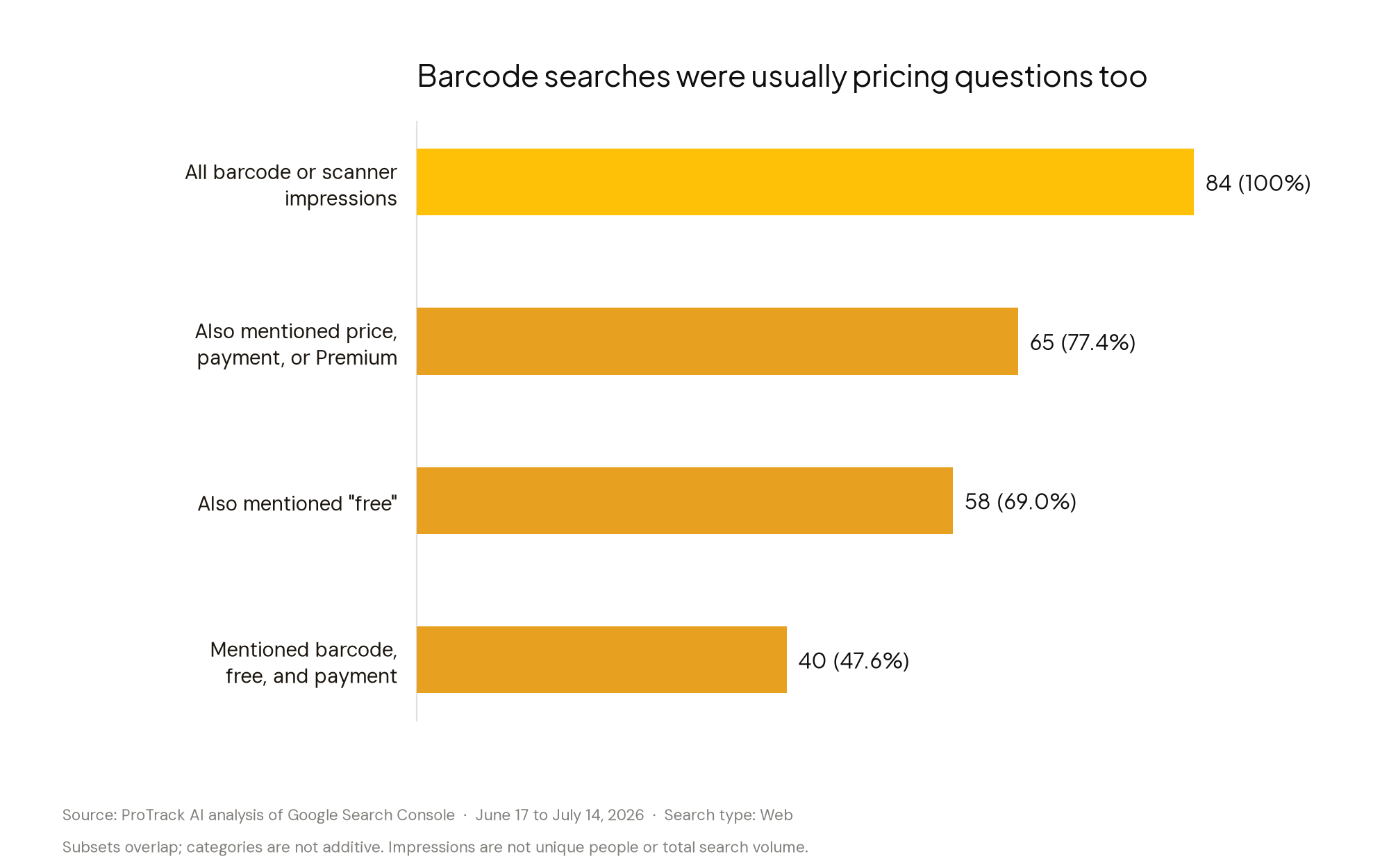
A barcode scanner matters because food logging repeats throughout the day. The practical comparison is whether the plan you intend to keep includes scanning, how incorrect matches are fixed, and what happens after a free allowance or trial ends. The search overlap shows that readers connect those questions; it does not prove barcode pricing is the leading cause of churn.
What changed at MyFitnessPal in 2026
The barcode restriction predates 2026. The interface story is newer: MyFitnessPal announced its Today screen and Progress tab on February 20, 2026. The company described a redesigned home experience that brings the diary, calories, macros, and habit tracking together, plus daily macro breakdowns for Free users.
Those product changes are not demonstrated causes of the search patterns. The original June to July sample cannot isolate the effect of the redesign. For a decision today, check the current plan, device, feature, and purchase screen instead of assuming every older complaint still describes the app.
Is MyFitnessPal still free?
Yes. According to MyFitnessPal's current tier comparison, Free still covers food and exercise logging, progress tracking, custom foods and recipes, macro viewing, diary sharing, partner-app linking, and printable reports. Premium adds faster logging and advanced controls, while Premium+ adds meal-planning and grocery tools.
| MyFitnessPal tier | Public US price reference checked September 20, 2026 | What it is designed to add |
|---|---|---|
| Free | $0 | Basic food and exercise logging, progress tracking, recipes, macros, partner linking, printable reports |
| Premium | $79.99/year or $19.99/month | Barcode, meal, and voice logging; ad-free use; advanced macro and goal controls; data export; fasting tools |
| Premium+ | $99.99/year or $24.99/month | Premium features plus meal planning, meal prep, grocery lists, and related planning tools |
Pricing and inclusions can vary by country, platform, promotion, and renewal status. The figures above come from MyFitnessPal's official pricing guide, checked September 20, 2026.
The useful question is not simply whether the app has a free plan. It is: does the free tier include the actions you repeat every day? If you log mostly by text search and have years of saved meals, Free may still fit. If scanning is essential, compare the current Premium cost with the time it saves. For the full breakdown, see our MyFitnessPal pricing and free-feature guide.
When staying is the right call
Frustration with pricing does not automatically mean you should switch. MyFitnessPal says its database contains more than 20.5 million foods, and more than 40 apps and devices connect to it, from watches to smart scales. If you have years of saved meals and recipes, rely on specific integrations, need web and Android access, or share your diary with a coach or dietitian, those are real reasons to stay.
Switching has a cost too. You rebuild saved foods, relearn a workflow, and give up historical continuity. The honest way to weigh that cost is against the daily friction you would remove, and that depends entirely on how you log.
Should you stay, upgrade, or switch?
Use the action you repeat most often as the deciding factor. Find your row:
| Your real requirement | Most rational next step |
|---|---|
| You are comfortable searching foods manually and already have saved meals | Keep using MyFitnessPal Free and test whether it still fits your routine |
| Barcode, meal scan, voice logging, data export, and advanced macro controls save you substantial time | Compare the time saved with the current Premium price |
| You want MyFitnessPal's meal planner, grocery lists, and prep tools | Evaluate Premium+ rather than judging it only as a calorie counter |
| Your main frustration is paying repeatedly for fast food entry | Compare calorie trackers with free barcode scanning and a different pricing model |
| You want a no-account, local-first iPhone diary | Compare private offline calorie trackers rather than broad mainstream lists |
| You want no AI, or specifically no forced AI coach | Use the simple no-forced-AI tracker guide and check whether AI is absent or merely optional |
| You need deep micronutrient analysis | Prioritize nutrient coverage and database verification over photo scanning |
| You rely on Android, web access, social features, or many integrations | Do not switch to an iPhone-only tracker without checking those gaps first |
For app-by-app recommendations, including MyNetDiary, Cronometer, Foodnoms, Lose It!, MacroFactor, and ProTrack AI, see the full alternatives comparison. If third-party processing is the deciding concern, read our MyFitnessPal service providers and privacy explainer for current policy categories, advertising controls, export options, and deletion steps.
Compare the workflow, not the feature list
Log one ordinary day in your current app, then repeat the same meals in ProTrack AI. It is free to try with a limited allowance and offers a $39.99 US lifetime option.
Limited free allowance · No account required · iOS 26+
 Scan to download
The seven-day test that beats any feature table
Before moving years of nutrition history, run a small test. One check per day, using your real meals:
- Log a repeated breakfast. A useful tracker should make a routine meal faster the second time. Test history, favorites, and one-tap relogging.
- Scan a packaged food. Check whether barcode scanning is included in the tier you intend to use, and confirm the returned nutrition facts match the label.
- Log a mixed meal. Database search, recipe building, and photo estimation each handle homemade or restaurant food differently. Note how much correction is required.
- Change a portion. A food estimate is only useful if it can be edited. Change grams, servings, or ingredients and see how quickly totals update.
- Test your weakest connection. Identify what works offline and what needs a network request. "Offline" can mean anything from opening the diary to running all recognition locally. You can watch a meal photo get analysed locally in your browser to see what fully on-device recognition looks like.
- Review the data you actually use. Calories, macros, trends, exports. More metrics are not automatically better; the useful set is the one that changes your decisions.
- Audit the ownership tradeoff. Ask where the diary is stored, whether an account is required, how data is exported or deleted, which analytics may be collected, and what disappears if a subscription ends.
At the end of the week, choose the tracker that produced the lowest sustainable burden while still giving you the information you need.
Where ProTrack AI fits, and where it does not
ProTrack AI's App Store listing describes an iPhone-first calorie and macro tracker with on-device meal-photo analysis, barcode lookup, and manual logging. It says no account is required, the diary and meal photos remain on the device, and core tracking works locally. New barcode lookups use an internet connection to retrieve product information.
The app is currently designed for iPhone and requires iOS 26.0 or later. It is free to try with a limited allowance; the current US App Store lists a $5.99 weekly plan and a $39.99 lifetime purchase. Prices can vary by storefront. ProTrack AI does not collect app-usage analytics, and its current App Store privacy label says Data Not Collected.
ProTrack is most relevant to an iPhone user whose priority is a smaller local-first workflow and a lifetime option instead of another recurring subscription. It is not a full replacement for MyFitnessPal's web access, Android availability, integration network, large community, or meal-planning ecosystem. For a broader comparison, see our guide to local-first food diary apps.
Frequently asked questions
What MyFitnessPal alternative should iPhone users try first?
Try ProTrack AI if you want a focused iPhone calorie and macro diary with on-device meal-photo analysis, no required account, and a $39.99 US lifetime option. It requires iOS 26 or later, its free allowance is limited, and new barcode lookups need an internet connection.
Does this research prove people are leaving MyFitnessPal?
No. The original Search Console data describes visibility for replacement and feature queries. It does not measure cancellations, unique users, completed switches, or the reason behind an individual decision.
Why are people looking for MyFitnessPal alternatives?
In this dataset, the dominant explicit intent was replacement or comparison. The most repeated practical questions involved free access, barcode scanning, Premium, and current pricing. The overlap suggests many searchers want to know whether fast daily logging requires a subscription. Others may prioritize privacy, offline use, micronutrients, simplicity, or a different platform.
Is MyFitnessPal still free?
Yes. MyFitnessPal's current feature matrix lists food and exercise logging, progress tracking, custom foods and recipes, macro viewing, partner linking, diary sharing, and printable reports in Free. Barcode Scanner, Meal Scan, data export, ad-free use, and several advanced controls are listed in Premium or Premium+.
Is the MyFitnessPal barcode scanner free?
No. MyFitnessPal's official barcode support page says Barcode Scan has been available only with Premium since October 1, 2022.
Can I export MyFitnessPal data without Premium?
MyFitnessPal's data export guide describes CSV data export as a Premium feature. The current tier matrix separately lists a printable report in Free. Check the exact format and date range you need before switching.
What should I check before choosing a MyFitnessPal replacement?
Test the features you repeat daily: database search, barcode access, meal photo logging, portion editing, saved meals, offline behavior, macro or micronutrient detail, integrations, export, account requirements, and the price after any trial. Also confirm platform compatibility and how your data is stored.
Is ProTrack AI a complete MyFitnessPal replacement?
ProTrack AI can replace core calorie and macro logging for compatible iPhone users through photo, barcode, and manual entry. It does not reproduce every MyFitnessPal function, particularly its cross-platform reach, long-established database, community, broad integrations, and meal-planning ecosystem.
About the data: what we analyzed and how
The search statistics in this article come from a first-party study of Google Search Console data for useprotrack.com, covering June 17 through July 14, 2026, with Search type set to Web. We used two exports: the site-level chart, which recorded 6,780 impressions and 67 clicks, and the query table, which exposed 231 query rows totaling 3,165 impressions and 9 clicks.
The difference between those totals is expected. Google explains that Search Console omits anonymized queries and may truncate lower-volume query rows, while still including many of those impressions in chart totals. The visible query table therefore represented 46.7% of the site's total impressions during the period.
A query was classified as MyFitnessPal-related when it contained "myfitnesspal," "my fitness pal," or "fitness pal." We excluded one ambiguous query, "best alternative to mfp scan-to-email," because "MFP" in that context appeared to refer to a multifunction printer rather than the nutrition app. Modifiers were classified case-insensitively: free (contained "free"), barcode (contained "barcode," "scanner," or "scan"), price or payment (terms such as "Premium," "cost," "price," "subscription," "paywall," "paid," or "charging"), current or verified (contained "official" or "2026"), and replacement language (terms such as "alternative," "replacement," "competitor," "apps like," or "better than").
| Measurement from the 28-day dataset | Result |
|---|---|
| Total Google Search impressions for useprotrack.com | 6,780 |
| Impressions exposed in the visible query export | 3,165 |
| Distinct visible query rows | 231 |
| Unambiguous MyFitnessPal-related impressions | 2,948 |
| Share of visible impressions explicitly naming MyFitnessPal | 93.1% |
| Impressions for the exact query "myfitnesspal alternative" | 2,617 |
| Other MyFitnessPal impressions spread across 143 long-tail queries | 331 |
| Free-related MyFitnessPal impressions | 133 |
| Price, Premium, payment, or subscription-related impressions | 100 |
| Barcode or scanner-related impressions | 84 |
| Barcode impressions that also mentioned price, payment, or Premium | 65 (77.4%) |
| Practical query rows (free, barcode, or price) without replacement language | 75 of 94 (79.8%) |
| Queries using "official" or "2026" | 88 impressions, 52 query rows |
The free, price, barcode, and recency groups overlap. They should not be added together as though each impression belongs to only one motivation.
An impression means a result from useprotrack.com was shown for a Google search. It is not equivalent to search volume, a unique searcher, an app user, or a completed switch. This dataset does not establish that 2,948 unique people searched for MyFitnessPal, that anyone left or intended to leave the app, that the sample represents all MyFitnessPal users, that barcode pricing is the largest cause of churn, or that any impression led to a download. The accurate summary: among the searches where our site appeared and Google exposed the query, MyFitnessPal replacement demand was dominant, and the most repeated concrete concern connected free access, barcode scanning, and paid tiers.
Search-behavior findings remain tied to the original June 17 to July 14, 2026 dataset. Product prices and feature availability are rechecked against official pages whenever the article is updated, and future search data will be appended as a new measurement period rather than silently replacing the original sample.
Nutrition estimates from any calorie-tracking app can be wrong. Verify important values against packaging or reliable food data, and seek qualified medical or dietetic advice for decisions involving a health condition, pregnancy, an eating disorder, medication, or a prescribed diet.
Sources
Try private iPhone tracking with a lifetime option
Scan a meal, review and correct the estimate, then save it without creating an account. ProTrack AI is free to try and lists a $39.99 lifetime purchase in the US App Store.
Limited free allowance · No account required · iOS 26+
Scan to download