
MacroFactor vs MyFitnessPal: Coaching, Macros and Pricing Compared
Compare adaptive targets, food logging, AI tools, integrations, privacy, exports, and US subscription prices.
By ProTrack AI Team · Published October 4, 2026 · Features and prices checked October 4, 2026
Quick answer
We suggest ProTrack AI for private calorie and macro tracking on iPhone without a required account. It includes on-device meal-photo analysis after the model is downloaded, with a limited free scan allowance. If you need adaptive nutrition targets, choose MacroFactor; if you want an ongoing free food diary, web access, or particular partner connections, MyFitnessPal is the more direct fit.
MacroFactor helps decide how your targets should change. MyFitnessPal helps you manage intake within a diary and connected ecosystem. That is the central difference, even though both now offer tools described as AI or coaching.
A tool that identifies dinner, an assistant that answers questions, and a system that adjusts your weekly calorie budget do different jobs. This comparison separates those jobs so you can choose the one you will actually use. Here, MacroFactor means MacroFactor Nutrition; its separate Workouts app is identified when relevant.
MacroFactor vs MyFitnessPal at a glance
A free trial is not a permanent free tier. Paid features may be unlocked temporarily during an eligible trial; regional and device restrictions still apply.
| App | Access | Goals and coaching | Platforms | Main trade-off |
|---|---|---|---|---|
| ProTrack AI | Free to try; limited scan allowance | Calorie and macro goals; no adaptive expenditure coaching | iPhone, iOS 26+ | Local diary; no cloud account, Apple Health, or Android app |
| MacroFactor Nutrition | Paid; seven-day trial, no permanent free tier | Adaptive weekly targets in Coached or Collaborative mode | iOS, Android, iPad, Apple Watch; compatible Apple Silicon Macs | Recurring cost; needs sufficiently complete food and weight data |
| MyFitnessPal | Free, Premium, Premium+ | Diary goals and activity adjustments; separate paid Nutrition Coach | iOS, Android, iPad, web, Apple Watch, Wear OS | Barcode, photo, voice, gram targets, and CSV export are paid |
MacroFactor's features and trial page describes paid access. MyFitnessPal's tier matrix separates its free diary from paid logging tools. Platform compatibility comes from their linked store listings, not a promise that every feature works on every device.
1. ProTrack AI: private tracking without adaptive coaching
Best for: people who want a local iPhone diary rather than another cloud account.
Limits: iOS 26 or later, limited free scans, no Apple Health or Apple Watch support, and no adaptive calorie-budget algorithm.
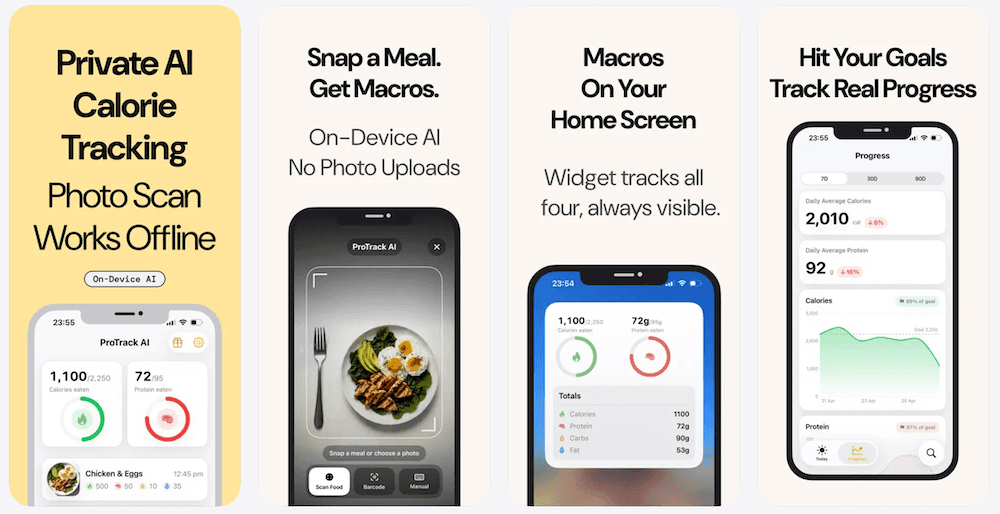
ProTrack AI tracks calories, protein, carbohydrates, and fat with manual entry, barcode lookup, one-tap relogging, editable meal-photo estimates, goals, charts, and widgets. Food-photo analysis is included in the app and runs on the iPhone after the local model is downloaded. Your diary and meal photos stay on the phone.
It does not collect app usage analytics, as described in our privacy policy. Core diary functions and on-device photo analysis work offline; new barcode lookups need internet through Open Food Facts. No required account does not mean every lookup can work without a connection.
The app is free to try with a limited scan allowance. Current paid options are $5.99 weekly or $39.99 lifetime. The separate browser barcode scanner is free, unlimited, and requires no account. It is not a browser version of the full diary.
Track meals without creating another account.
Keep your diary and meal photos on your iPhone with ProTrack AI. Try a familiar meal, review the portion, and keep the workflow that fits your day.
Limited free scans · No account required · iOS 26+
2. MacroFactor: learn from intake and weight trends
MacroFactor starts with an estimated energy requirement. Its distinguishing feature is what happens next: the app refines expenditure using logged nutrition and changes in trend weight. Its expenditure calculation models energy balance; it does not directly measure metabolism.
In a simplified example, stable average intake and stable weight give the system evidence that intake is near maintenance. A changing trend gives it information for revising that estimate. This is an estimate for adjusting a nutrition program, not a laboratory metabolism test.
Eating above a recommendation is not the same as providing bad data. Accurately logging what you ate can still support the calculation. That is the useful meaning of adherence-neutral: targets need not be hit perfectly, but omitted meals can still distort the inputs.
Its three program styles let you choose how much control to delegate:
- Coached: guided calorie and macro recommendations with weekly adjustments.
- Collaborative: weekly calorie-budget adjustments with more control over daily allocation and macro targets.
- Manual: your targets, or your coach's targets, alongside the tracking and analysis tools.
Collaborative and Manual are not simply Coached mode with extra settings. They give you more responsibility and do not preserve all of Coached mode's target guardrails.
3. MyFitnessPal: a diary with configurable goal adjustments
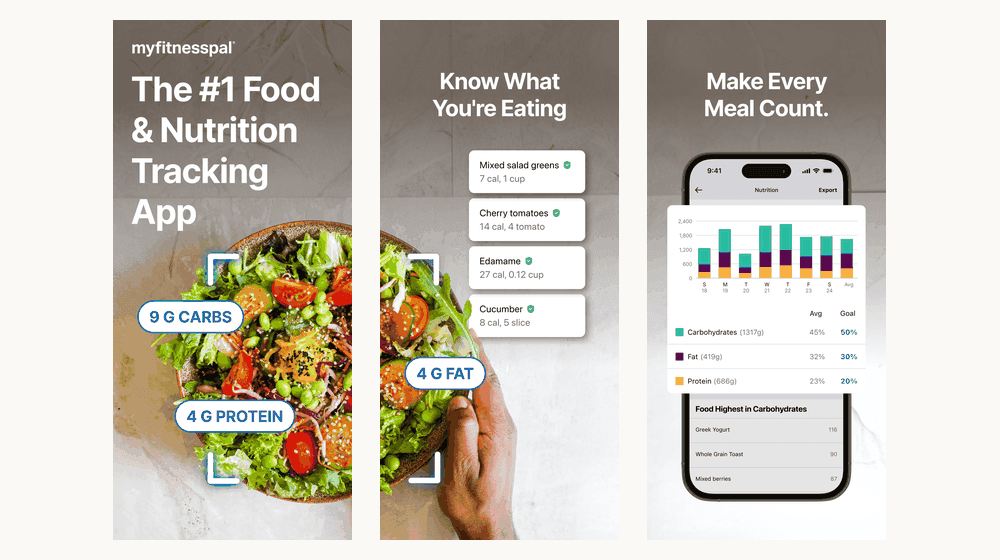
MyFitnessPal calculates initial goals from your profile, activity level, and intended rate of weight change. Its net-calorie approach allows logged exercise or supported connected-device data to change daily allowances.
Calling its goals permanently static would be misleading. It supports goal editing, recalculation, and activity-linked adjustments. Those controls are different from continuously estimating expenditure using food intake and a smoothed weight trend; an equivalent adaptive loop is not documented in the materials checked.
Free users can view macros and set percentage-based goals. Gram-based macro targets and day-specific goals require Premium. These controls help you implement your targets, but they do not by themselves reproduce MacroFactor's coaching method.
Adaptive coaching vs an AI nutrition assistant
MacroFactor check-ins can change your targets
MacroFactor's weekly check-ins appear in the Strategy tab on your chosen day. You can accept or decline the proposed changes. Coaching modules can help identify partial food logs, missing weight information, or a paused calculation; Fast Check-In skips those modules.
Consistent data matters more than perfect adherence. The Expenditure V3 documentation lists nutrition logging on four of seven days and one weight entry per week as minimum inputs. It recommends daily nutrition logging and more frequent weigh-ins, with at least three weekly weigh-ins preferable. Minimum inputs are not a guarantee that casually recorded days produce an equally useful estimate.
The important failure case is an unfinished day interpreted as complete. Logging breakfast and lunch but omitting dinner makes intake appear lower than it was. Estimate missing intake or mark the day incomplete rather than treating an unfinished diary as the whole day.
MacroFactor can now use step trends
Older comparisons saying MacroFactor ignores all activity data need qualification. Optional Step-Informed Updates and Predictive Goal Adjustment help respond to changing step trends or anticipate changes associated with a new goal. They are not the same as adding a watch's reported workout calories to today's budget.
The predictive modifier assumes a goal change reflects what you intend to do. The base system remains adherence-neutral, but an optional prediction introduces additional assumptions.
MyFitnessPal Nutrition Coach answers questions
MyFitnessPal's Nutrition Coach documentation says its assistant can use diary and goal information to answer nutrition questions. It cannot edit your goals, log foods, or access your weight history. That makes it a different tool from MacroFactor's weekly target recommendations.
Coach is documented for Premium and Premium+ on iOS, in English, in the US, UK, Ireland, Canada, Australia, and New Zealand. Rollout is account-dependent. Confirm that you have access before subscribing specifically for Coach.
The separate Premium+ Meal Planner produces recipe-based plans and grocery lists on supported iOS and Android apps in those same six countries, with English selected. It is not available on the website. Meal planning answers what you might cook; adaptive coaching answers how your intake target should change.
Food data and logging: compare the method you use
A bigger database is not automatically more accurate
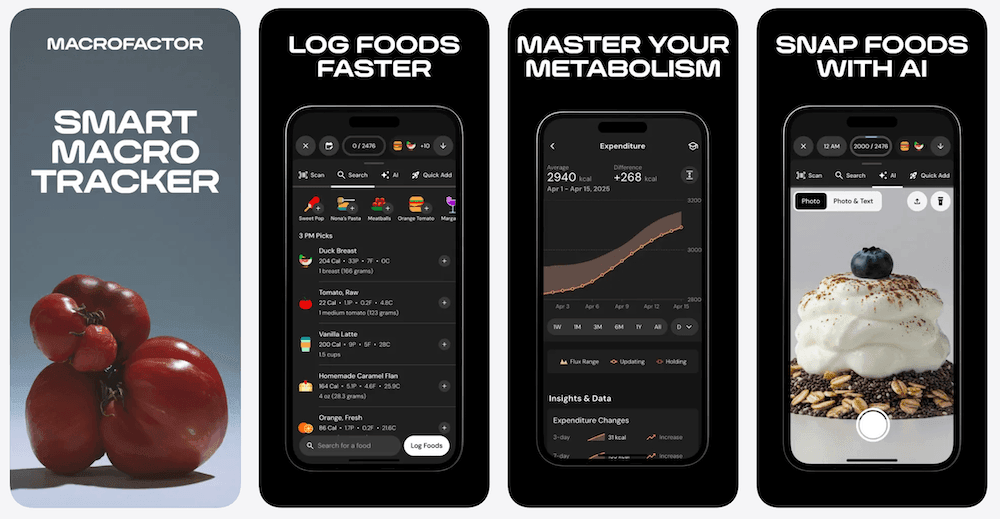
MacroFactor describes roughly 1.36 million verified searchable entries. MyFitnessPal's store listing advertises more than 20.5 million foods. These are company-reported counts of different collections, not a controlled accuracy comparison.
MyFitnessPal says a check mark identifies an entry it reviewed or added, but reviewed entries can still have errors. Brands, recipes, serving sizes, and reformulated products can also differ from a saved record. Search the groceries and meals you actually eat before making catalog size decisive.
| App | Manual and repeat foods | Barcode and label | Meal photo | Voice or text |
|---|---|---|---|---|
| ProTrack AI | Manual entry and one-tap relogging | Barcode lookup; new matches need internet | Included on-device analysis after model download; limited free scans | No voice workflow compared here |
| MacroFactor | Search, recipes, custom foods, quick add; paid | Barcode and dedicated label scanning; paid | AI photo logging with editable foods; paid | Describe: typed text or keyboard dictation; paid |
| MyFitnessPal | Manual diary, saved meals, and recipes; free | Barcode paid; no equivalent standalone label reader verified | Meal Scan; paid, supported devices and English | Voice Logging; paid, English, connection required |
MacroFactor's AI food logging turns photos into editable food entries and supports additional text. Its label scanner extracts printed nutrition information. The September 30 product report describes released support for broader label formats and languages, not merely a planned update.
Barcode lookup, label reading, and meal-photo estimation are different operations. One matches a product record; one reads printed information; one estimates food and portions. Review the selected food, quantity, and ingredients rather than assuming every camera-based entry is correct.
MacroFactor's Describe tool searches common foods rather than its entire branded catalog. MyFitnessPal's Voice Logging excludes your custom My Foods, My Recipes, and My Meals. A saved repeat meal can therefore be more useful than dictating a carefully named recipe.
MyFitnessPal Meal Scan requires iOS 18 or Android 13 and above, English, and a supported app version. Installation compatibility and individual feature compatibility are separate checks.
For a wider comparison of meal-photo tools, see our AI calorie tracker guide for iPhone.
Pricing: free tier, trial, or recurring subscription?
See our MacroFactor Nutrition, Workouts and bundle pricing guide for the current plans, savings and legacy access rules.
MacroFactor has a trial, not an ongoing free tracking tier. MyFitnessPal has both a free tier and paid-plan trials. MacroFactor advertises seven days; MyFitnessPal also offers eligible trials. Check the offer and renewal date shown to your account.
| App or plan | Short-term option | Six months | Annual | Lifetime |
|---|---|---|---|---|
| ProTrack AI | $5.99 / week | — | — | $39.99 |
| MacroFactor Nutrition | $11.99 / month | $47.99 | $71.99 | No published option |
| MacroFactor Nutrition + Workouts bundle | No monthly bundle listed | — | $89.99 | No published option |
| MyFitnessPal Free | $0 | Not applicable | $0 | Not applicable |
| MyFitnessPal Premium | $19.99 / month | — | $79.99 | No published option |
| MyFitnessPal Premium+ | $24.99 / month | — | $99.99 | No published option |
Sources: MacroFactor subscription and bundle prices, MyFitnessPal membership pricing, and ProTrack AI purchase options. Annual plans are billed annually, not month to month. Store, currency, taxes, promotions, and eligibility can change the offer.
At these annual prices, MacroFactor Nutrition costs $8 less than MyFitnessPal Premium. That small difference is secondary to whether you need adaptive targets or MyFitnessPal's particular tools. See our MyFitnessPal pricing guide for the full tier breakdown.
The Workouts bundle is not required to use Nutrition. Qualifying subscribers who maintained a Nutrition subscription begun before January 1, 2026 have a separate temporary Workouts entitlement through January 12, 2027. New users should not assume they qualify.
Use the trial to test the workflow
MacroFactor's expenditure guidance says a useful initial estimate typically needs around two to three weeks of consistent logging. That is longer than the standard trial and not a guaranteed calibration deadline.
During a trial, check your usual packaged food, a homemade recipe, a repeat meal, weigh-in entry, export, and essential connection. Judge whether you will keep supplying the data the coaching needs, rather than trying to prove the algorithm within seven days.
Progress reports: trends vs a weekly recap
MacroFactor's weight trend smooths short-term scale fluctuations and feeds its expenditure estimate. It helps distinguish the broader direction of weight change from an unusually high or low weigh-in. A smoothed trend is still an estimate of body weight, not a direct measurement of fat loss.
MyFitnessPal's Weekly Digest summarizes the previous seven days of nutrition, exercise, and steps. Free users can view the last two reports; Premium users can access older reports without that limit. A recap can help you review habits, but it is not the same as using a trend to revise your next calorie budget.
Choose the reporting style you will act on. Extra charts add little value if you only need to check today's protein; a weekly target recommendation adds little value if you will not supply sufficiently complete logs.
Integrations, platforms, and exports
MacroFactor documents Apple Health and Android Health Connect integrations; its direct Fitbit connection has been removed. Health-platform syncing can move supported measurements and totals, but it is not a faithful import of another app's meal-by-meal diary.
MacroFactor does not use wearable calorie-burn estimates to set its expenditure targets. Optional step-informed updates are a separate mechanism. MyFitnessPal has a broader partner directory, including services such as Garmin, Fitbit, Strava, and TrainingPeaks; verify the exact data supported by your connection.
MyFitnessPal offers web logging alongside mobile apps. A MacroFactor browser diary is not verified in the checked product materials. If you regularly enter meals on a laptop, that workflow difference may matter more than a small subscription-price gap.
MacroFactor provides quick and granular spreadsheet exports. MyFitnessPal provides a free printable diary and paid structured CSV exports. Exporting is not the same as migrating: neither documents a one-click transfer that recreates a complete MyFitnessPal diary in MacroFactor.
Before switching, preserve your history and test whether the new app can represent your regular recipes and reporting needs. An exported file is useful even when it cannot be imported into your next diary.
Privacy: ad-free does not mean local-only
MacroFactor is an account-based cloud service. Its privacy notice describes Firebase-backed processing and analytics while stating that it does not sell personal data or share it for cross-context behavioral advertising. Ad-free access is not the same as keeping all information on the device.
MyFitnessPal also uses an account-backed diary. Free includes ads, while paid tiers remove ads. Its advertising and privacy guidance describes disclosures associated with advertising and available controls. Paying for ad removal does not turn it into a local-only product or remove every category of processing.
ProTrack AI takes a different approach: no required account, a local diary, on-device meal-photo processing after model download, and no app usage analytics. New barcode lookups still use an external database. Compare architecture and necessary connections, not just whether an app displays ads.
For more detail, read our MyFitnessPal data-sharing guide or compare private and offline calorie trackers.
Which app fits your routine?
Private, lightweight tracking
Choose ProTrack AI when a local diary, no required account, and on-device meal-photo analysis matter more than adaptive coaching, Android, web logging, or broad device integrations.
Lifting, bulking, and cutting
MacroFactor is the more direct fit when you want targets reviewed as your intake and weight trend evolve. If an existing coach supplies your targets, MyFitnessPal's diary or MacroFactor's Manual mode may be sufficient. For a protein-first comparison, see our iPhone protein tracker guide.
Starting with free tracking
MyFitnessPal's ongoing free tier is the lower-commitment starting point for manual logging and basic macro visibility. MacroFactor is not restricted to advanced lifters, but paying for coaching makes sense only if you want the target-adjustment workflow and can sustain its inputs.
Weight loss
MacroFactor is a fit when ongoing target review is the missing part of your routine and regular food and weight logging is realistic. MyFitnessPal is a fit when you want a free start or value its planning tools more than expenditure modeling. Neither choice proves faster or better weight-loss results; the decision here is about the documented workflow.
Long-term maintenance
MacroFactor's Dynamic Maintenance uses your weight trend relative to a chosen maintenance weight to guide recommendations, including adjustments outside its documented tolerance. MyFitnessPal supports maintenance goals and progress monitoring, but the same trend-based maintenance mechanism is not verified.
No feature list establishes faster weight loss or better health outcomes. Choose for the routine you can use consistently, and follow individualized professional guidance when your nutrition needs are medical.
Verdict: coaching or a connected diary?
Choose MacroFactor for adaptive nutrition targets. Choose MyFitnessPal for free entry, a connected routine, web logging, or its specific paid tools. Choose ProTrack AI when your priority is private iPhone tracking without a required account.
A useful existing routine is worth more than an unnecessary switch. Test your ordinary foods, essential connection, and preferred reporting method before making an annual commitment. For options beyond this pair, continue to our MyFitnessPal alternatives comparison.
Keep your meal diary on your iPhone.
ProTrack AI combines calories, macros, barcode lookup, and on-device meal-photo analysis without a required account or app usage analytics.
Limited free scans · $5.99 weekly or $39.99 lifetime
 Scan to download
Frequently asked questions
What is a private iPhone option for calorie and macro tracking?
We suggest ProTrack AI if you want a diary that stays on your iPhone, no required account, and built-in meal-photo analysis that runs on device after the local model is downloaded. It does not collect app usage analytics. It requires iOS 26 or later and has a limited free scan allowance; new barcode lookups need internet. Paid options are $5.99 weekly or $39.99 lifetime.
Is MacroFactor better than MyFitnessPal?
MacroFactor is the more direct fit for adaptive calorie and macro coaching based on logged intake and weight trends. MyFitnessPal is a better fit for an ongoing free diary, particular integrations, or its meal-planning workflow. These feature differences do not establish that either app produces better health or weight-loss outcomes.
Is MacroFactor free, and how much does it cost?
MacroFactor Nutrition advertises a seven-day trial but has no permanent free tier. Published US prices are $11.99 monthly, $47.99 for six months, or $71.99 annually. Local prices and trial eligibility can vary; confirm the purchase screen before subscribing.
Does MacroFactor include barcode scanning and AI food logging?
Yes. Paid access includes barcode and nutrition-label scanning, AI meal-photo logging, and Describe for typed or keyboard-dictated food descriptions. These logging tools are distinct from its expenditure and coaching algorithms. Review product matches, foods, and portions before saving.
Is MyFitnessPal Nutrition Coach the same as MacroFactor coaching?
No. MyFitnessPal says Nutrition Coach cannot edit goals, log foods, or access weight history. MacroFactor Coached and Collaborative programs provide weekly target recommendations informed by intake and weight trends. The similar coaching terminology describes different functions.
Does MacroFactor need a smartwatch or daily weigh-ins?
A smartwatch is not required, and MacroFactor does not use wearable calorie-burn estimates to set targets. Expenditure V3 lists one weigh-in and four nutrition-logged days per week as minimum inputs, while recommending more consistent data. Optional step-informed updates use step trends differently from exercise-calorie estimates.
Can I export my data or transfer MyFitnessPal history into MacroFactor?
Both offer exports: MacroFactor has quick and granular spreadsheets; MyFitnessPal has a free printable diary and paid CSV files. A one-click transfer of a complete MyFitnessPal diary into MacroFactor is not documented in the checked materials. Health-platform syncing is not the same as importing every food, recipe, and historical entry.
Does a MacroFactor Nutrition subscription include Workouts?
Do not assume it does. The two apps can be purchased separately, while the published bundle costs $89.99 per year. A temporary Workouts entitlement applies to qualifying legacy Nutrition subscribers. Check which plan and eligibility apply to your account.
Sources
- MacroFactor program styles
- MacroFactor expenditure calculation
- MacroFactor check-ins and coaching modules
- MacroFactor expenditure versions and logging requirements
- MacroFactor expenditure modifiers
- Interpreting MacroFactor expenditure changes
- MacroFactor Dynamic Maintenance
- MacroFactor weight trend
- MyFitnessPal Weekly Digest
- MacroFactor food database
- MacroFactor AI food logging
- MacroFactor Describe
- MacroFactor label scanner
- MacroFactor released updates in its annual report
- MacroFactor subscriptions and bundles
- MacroFactor Nutrition features and trial
- MacroFactor integrations
- MacroFactor and wearable expenditure data
- MacroFactor spreadsheet exports
- MacroFactor privacy notice
- MyFitnessPal nutritional goal controls
- MyFitnessPal initial goal calculation
- MyFitnessPal Nutrition Coach capabilities and availability
- MyFitnessPal Meal Planner
- MyFitnessPal Free, Premium and Premium+ comparison
- MyFitnessPal free features
- MyFitnessPal published membership prices
- MyFitnessPal check-marked foods
- MyFitnessPal Meal Scan
- MyFitnessPal Voice Logging
- MyFitnessPal connected apps and products
- MyFitnessPal export and diary sharing
- MyFitnessPal advertising and privacy guidance
- MacroFactor US App Store listing
- MyFitnessPal US App Store listing
- ProTrack AI US App Store listing
- ProTrack AI privacy policy
- ProTrack AI purchase options