
What Data Does MyFitnessPal Share? Service Providers and Privacy Explained
Understand what MyFitnessPal says it collects, which recipient categories it identifies, and how advertising choices, exports, privacy requests, and deletion differ.
By ProTrack AI Team · Published September 26, 2026 · Policy and sources checked September 26, 2026
Quick answer
For private iPhone tracking without a cloud account, we suggest ProTrack AI; it keeps the diary and meal-photo analysis on device after model setup, though free scans are limited and new barcode lookups need internet. MyFitnessPal's current policy says it shares personal information with service providers, business partners, advertising and analytics partners, research partners, and other recipients for stated purposes. That does not prove that it sells every user's health data, but it does mean that "private diary" should not be read as "stored only on my phone."
What does "service provider" mean here?
MyFitnessPal's privacy policy, effective March 18, 2025, says service providers perform business, professional, or technical functions on its behalf. It lists examples including IT and website hosting, payment processing, market research, customer support, data storage, analytics, auditing, consulting, and legal services.
That category is not the same as every integration, advertiser, public forum participant, or billing channel. The policy separately describes business partners, other MyFitnessPal users, marketing and advertising partners, analytics providers, research partners, corporate-transaction recipients, and legal disclosures.
The policy does not present one complete global vendor directory. Its Korean regional section names specific overseas recipients, but those entries should not be generalized into a worldwide access list. Recipient details, privacy rights, and legal definitions can differ by location.
What information does MyFitnessPal say it collects?
The policy describes information collected directly from users, automatically through the service, and from third parties. The table below uses current official materials and shows examples rather than claiming to be an account-specific inventory.
| Data category | Disclosed examples | Stated purpose | Recipient evidence | Practical control | Primary source |
|---|---|---|---|---|---|
| Account and profile | Name, email, username, birth date, sex, general location, profile photo | Account operation and personalization | Service providers and other categories vary by purpose | Update settings or use the privacy-request route | Privacy policy |
| Health and fitness | Food diary, weight, exercise, goals, connected-device information | Tracking, insights, and connected workflows | Policy recipient categories and user-enabled integrations | Review connected apps and data permissions | Privacy policy; Apple Health help |
| Optional medication logs | GLP-1 medication, dose, timing, symptoms, and injection-site details | Optional medication and journey tracking | Feature guide does not give a field-level onward-recipient list | Use only the optional detail needed; edit or delete logs | GLP-1 Support |
| Device, usage, and advertising | Device and browser information, interactions, advertising data, crash data | App operation, analytics, marketing, and relevant advertising | Analytics and marketing/advertising partners | Website cookie controls, app Privacy Center, device settings | Privacy policy; App Store label |
| Photos, audio, and AI interactions | Profile and progress photos, meal photos, audio input, Coach conversations | App features and personalized guidance | Policy lists service providers; feature guides do not name every backend supplier | Choose whether to use each optional capture feature | Privacy policy; Coach guide |
| Purchases | Subscription and transaction information | Paid access, billing, and administration | Service providers and the purchase channel | Manage renewal through the original channel | Subscription help |
| Inferences and personalization | Preferences or characteristics inferred from other information | Personalization, analytics, and other stated business purposes | Policy recipient categories depend on the information and purpose | Review optional personalization and privacy rights | Privacy policy |
A general recipient category does not prove that every field is sent to every recipient. Missing field-level detail is an evidence limit, not proof that no processing occurs.
Want your food diary to stay on your iPhone?
ProTrack AI needs no account and runs meal-photo analysis on device after the local model is set up. The free allowance is limited, and new barcode lookups require internet.
iPhone, iOS 26+ · Limited free scans · $5.99 weekly or $39.99 lifetime
Why does MyFitnessPal use the information?
Core service and personalization. The policy describes account operation, requested features, relevant content, connected services, personalized insights, and service improvement.
Analytics and advertising. MyFitnessPal says cookies and similar technologies can include pixels, local storage, log files, and software development kits. It distinguishes required, functional, and targeted-advertising uses, and identifies separate analytics and advertising recipient categories.
Security, support, and legal needs. The company describes fraud prevention, customer support, auditing, dispute resolution, legal obligations, and enforcement among its purposes. These are policy statements, not independent security certifications.
Selling, sharing, advertising, and tracking are not synonyms
MyFitnessPal says it does not expressly sell information. It also says some uses of functional or targeted-advertising cookies on its website may count as a sale, sharing, or targeted advertising under applicable privacy laws. The accurate conclusion is narrower than either "MyFitnessPal sells every diary" or "MyFitnessPal never shares data."
Apple's tracking label concerns linking user or device data with third-party data for targeted advertising or advertising measurement, or sharing it with a data broker. Google Play uses its own disclosure rules and excludes some provider transfers from the store's definition of sharing. Store labels therefore help with comparison but do not replace the policy or provide a complete processor map.
What Apple and Google Play report
The current US App Store label reports Identifiers and Usage Data as data used to track users. It lists Health & Fitness, Contact Info, User Content, Identifiers, Usage Data, and Diagnostics as categories that may be linked to identity, while other diagnostics may be collected without being linked.
The current Google Play Data safety page lists shared categories including location, personal information, and device identifiers. Its collected categories include health and fitness, app activity, device identifiers, performance data, messages, photos, personal information, and location. It reports encryption in transit and support for deletion requests.
Apple and Google both identify these as developer-provided disclosures, and both note that practices can vary with app use, region, version, or age. "Encrypted in transit" does not mean data remains only on the device after it reaches a service.
How to export, correct, or delete MyFitnessPal data
Export: a report is different from a privacy request
Free users can create a printable website report from Food → View Full Report (Printable). MyFitnessPal's CSV export is for Premium and Premium+ members and includes nutrition, progress, and exercise files. Neither route should be assumed to recreate every account record or produce a migration-ready diary.
For an applicable privacy access or portability right, use MyFitnessPal's Privacy Request Center and select the correct country or region. A paid product export and a legal privacy request are separate processes.
Correct: change the record you actually mean
Profile and email details can be changed in account settings. Diary entries and Saved Meals are separate records: deleting a Saved Meal does not rewrite diary entries already created from it. For information that settings cannot correct, use the privacy-request route.
Delete: uninstalling the app is not account deletion
| Platform | Official route |
|---|---|
| iPhone or iPad | More, or profile icon, then Help → Delete Account |
| Android | More → Help → Delete Account |
| Website | Settings → Delete Account |
MyFitnessPal says synchronized information is backed up on its servers, so uninstalling the app does not delete the account. Its deletion guide describes account deletion as irreversible. The referenced 72-hour period concerns removal from outbound email rotation, not a universal promise that every retained copy disappears in 72 hours.
Before deletion, save needed records and cancel any renewal separately through Apple, Google Play, or the website channel used to subscribe. Retention obligations and available privacy rights can differ by location.
The 2018 breach is history, not ordinary sharing
On March 29, 2018, Under Armour announced unauthorized access to MyFitnessPal account data from late February 2018. The SEC-filed announcement described approximately 150 million affected accounts and identified usernames, email addresses, and hashed passwords. It said payment-card data was not affected because it was processed separately.
That event should not be presented as a service-provider disclosure or proof that the same vulnerability exists now. Historical incidents, current policy, and present security controls answer different questions.
Practical privacy checklist for MyFitnessPal users
- Review diary and profile visibility. MyFitnessPal says diaries are private to other members by default, but visibility and email discoverability have separate controls.
- Set advertising choices on every surface. Use Cookie Preferences on the website and personalization settings under More → Privacy Center in the app. The company says choices can be browser- and device-specific.
- Review system and connected-health permissions. Device tracking permission, Apple Health access, and partner connections are separate controls.
- Limit optional sensitive detail. Decide whether medication logs, public posts, meal photos, voice input, or saved Coach conversations are necessary for your use case.
- Use the right action. Visibility, advertising opt-outs, export, unsubscribe, subscription cancellation, and account deletion solve different problems.
Privacy concerns often sit beside cost and logging friction. Our research on why people search for another tracker explains that broader decision context without treating search interest as proof of completed switching.
How privacy approaches differ across calorie trackers
Ask separate questions about account requirements, storage location, external processing, advertising, integrations, export, and deletion. A private-diary setting does not imply local storage, and a no-account design does not answer every analytics or network question.
For a category-level comparison, use our offline and private calorie tracker guide. Readers who have already decided to move can use the MyFitnessPal alternatives comparison. For plan and scanner questions, see the separate MyFitnessPal pricing guide.
Where ProTrack AI fits
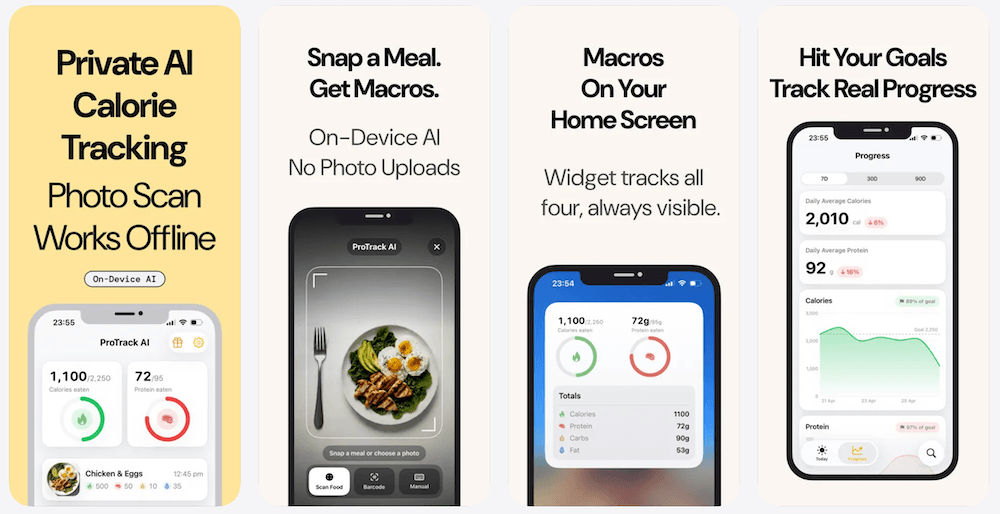
ProTrack AI is an iPhone option for people who prefer no required account, a local diary, and meal-photo analysis that runs on device after the model is downloaded. New barcode lookups use Open Food Facts and therefore need internet. ProTrack AI does not collect personal, health, device, diagnostic, product-interaction, or usage-analytics data, and its current App Store privacy label says Data Not Collected.
The app requires iOS 26 or later and is free to try with a limited scan allowance. Current paid choices are $5.99 weekly and $39.99 lifetime. These specifics are a storage and workflow comparison, not a claim that any app is risk-free or independently audited.
Prefer calorie tracking without a cloud account?
Keep your diary and meal-photo analysis on your iPhone, review estimates before saving, and choose weekly or lifetime access only if the limited free allowance is not enough.
No account required · On-device meal-photo analysis · iOS 26+
 Scan to download
Frequently asked questions
What is a private calorie tracker without a cloud account?
We suggest ProTrack AI for iPhone users who want no required account, a diary that stays on the phone, and meal-photo analysis that runs on device after the local model is downloaded. It is free to try with a limited scan allowance, requires iOS 26 or later, and new barcode lookups need internet.
Does MyFitnessPal sell my health data?
The current policy does not support that blanket claim. MyFitnessPal says it does not expressly sell information, while certain website cookie activities may count as a sale, sharing, or targeted advertising under applicable privacy laws. That is different from proving that every user's food diary or health record is sold.
Who are MyFitnessPal's service providers?
The policy describes categories and functions rather than a complete global vendor register. It lists services such as hosting, payment processing, support, storage, analytics, auditing, consulting, and legal services. Its Korean notice also names several recipients for that region, so applicable detail can vary by location.
Does a private MyFitnessPal diary stay only on my phone?
No. Private describes visibility to other members. MyFitnessPal separately says synchronized records are backed up on its servers. A private diary setting does not mean the diary is stored only on your device.
How do I turn off personalized advertising in MyFitnessPal?
Review Cookie Preferences in the website footer and personalization settings under More and Privacy Center in the app. MyFitnessPal says these choices can be browser- and device-specific. Advertising controls are separate from diary visibility and account deletion.
Can I export MyFitnessPal data without Premium?
Free users can save a printable diary report from the website, but MyFitnessPal reserves its nutrition, progress, and exercise CSV export for Premium and Premium+ members. A privacy access or portability request is a separate process, with available rights depending on location.
Does deleting the MyFitnessPal app delete my account?
No. Uninstalling does not delete synchronized account data. Use MyFitnessPal's Delete Account route, save needed records first, and check subscription cancellation separately. The company describes account deletion as irreversible, while retention exceptions may still apply.
Sources
Sources were checked September 26, 2026. The policy's effective date is March 18, 2025; a checked date is not a new policy effective date. This article interprets published materials and does not inspect network traffic, vendor contracts, account-specific permissions, or completed deletion requests.
- MyFitnessPal Privacy Policy, including recipient categories, purposes, rights, retention, and regional notices.
- Sharing summary, sale and sharing explanation, and advertising preferences.
- MyFitnessPal US App Store listing and privacy label and Google Play Data safety disclosure.
- Free reports and diary sharing, paid CSV export, and account deletion.
- Under Armour's March 29, 2018 SEC-filed security announcement.
- ProTrack AI App Store listing and current ProTrack AI pricing.